-
After-market Service
-
Suppliers

CATL Wins World Economic Forum’s MINDS Award for AI-Driven Next-Generation Battery Design
Davos, Switzerland | 19 January 2026 – CATL has been honored with the World Economic Forum's 2026 MINDS (Meaningful, Intelligent, Novel, Deployable Solutions) Award, recognizing its groundbreaking project "Augmented Intelligence Leading Next-Generation Lithium-ion Battery Design," which has been acclaimed as a global benchmark for AI-driven industrial application.
This project revolutionizes the lithium-ion battery R&D paradigm with augmented intelligence, delivering virtual batteries with superior performance, increased reliability, and higher efficiency while transforming human design into co-design between AI and customers.The MINDS programme, spearheaded by the World Economic Forum's Centre for AI Excellence, accelerates the responsible adoption of AI, data, and intelligent technologies to drive safe, fair, and collaborative transformation across industries, economies, and societies. Applicants are rigorously evaluated across five key dimensions—strategy, talent, data, technology, and governance—with only 15 organizations worldwide selected for this recognition this year.
In the official report, WEF highlighted:"By transforming battery cell design into a fully data-driven process, CATL is changing how next-generation EV batteries are developed...CATL turned a deep reservoir of proprietary, multimodal data into a sustained AI advantage."
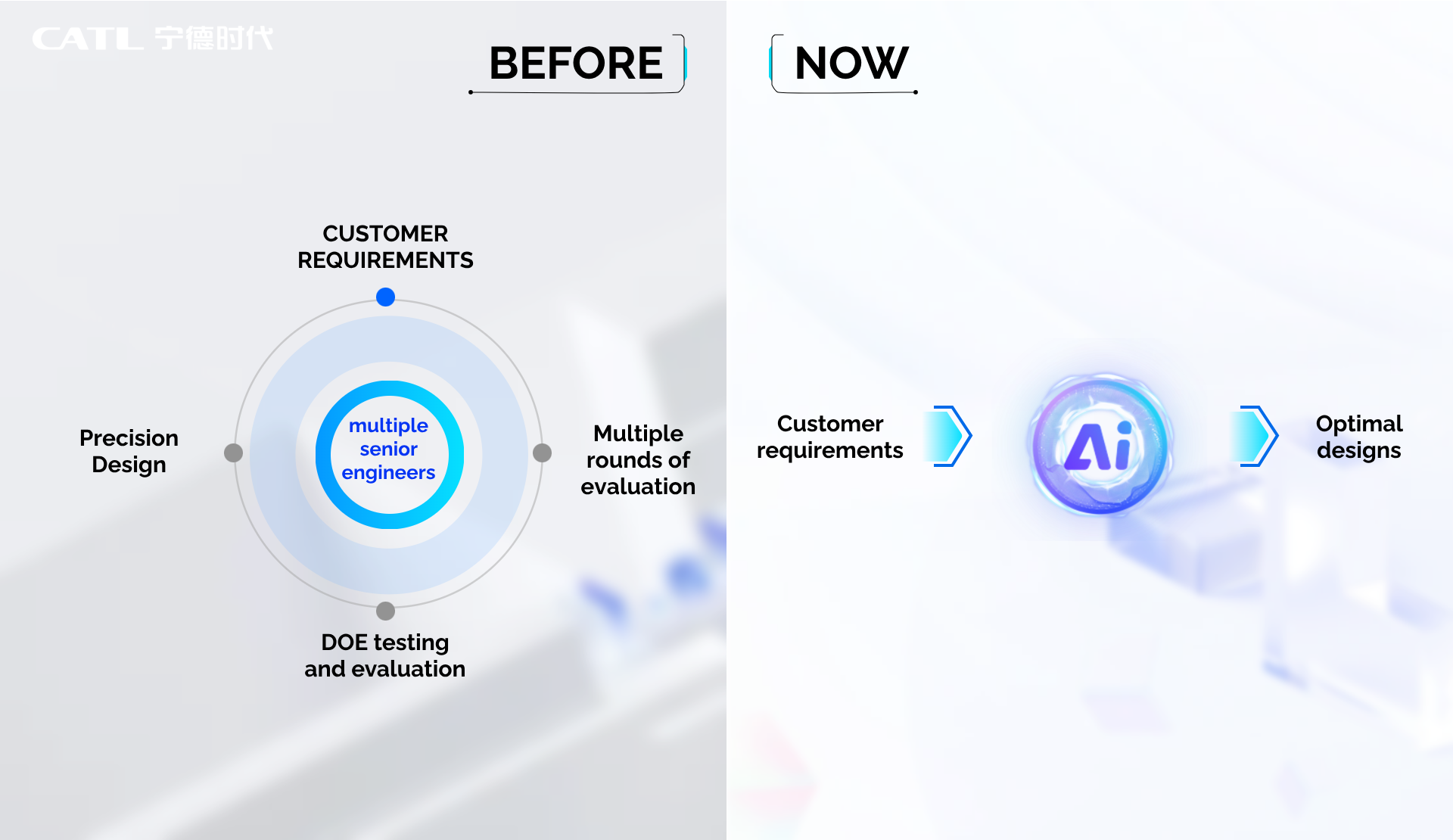
As penetration of the new energy vehicle (NEV) market surpasses 50 percent and electric vehicle development cycles compress to just 18 months, batteries with superior performance, higher quality and enhanced safety have become a decisive source of competitive advantage for automakers. Yet traditional lithium-ion cell design has long depended on individual engineers' experience and extensive manual testing, leading to prolonged evaluation cycles, high prototyping costs and repeated trial-and-error iterations across the industry.
CATL's Intelligent Cell Design project addresses these constraints by shifting the development model from reverse design and experimental trial-and-error to forward design and prediction before production. By integrating CATL's strengths across materials science, cell design, manufacturing processes and equipment, the company has built an intelligent design platform that redefines lithium-ion battery development.
The platform combines physics‑based electrochemical models with machine learning to deliver scientifically reliable predictions and speed up key steps in cell design. Running on an on‑premises private cloud, it draws on more than 50 million data records to strengthen its models. With physics‑informed machine learning and agentic AI, it works like a "digital engineer," automatically generating, evaluating and refining design options. This closed loop of data, physics and computation moves battery development beyond manual trial‑and‑error toward a more rigorous and automated process.
Trained on more than 100,000 battery design cases, 600TB of test data, and aftermarket data drawn from a broad range of NEVs, the platform can accommodate highly customised performance requirements, dynamically adjusting design priorities while achieving prediction accuracy of up to 95 percent. Compared with manual approaches, it delivers higher performance alongside improved reliability and efficiency. By evaluating designs against electrochemical constraints and applying AI-driven optimisation, it generates design recommendations in seconds and virtual cell designs in minutes.
"The MINDS Award is a significant recognition of our exploration in intelligent battery design," said Ni Jun, Chief Manufacturing Officer and Co-President of Engineering Manufacturing System of CATL. "In complex industrial scenarios like battery production, relying solely on 'Artificial Intelligence' can't solve core problems—I advocate more for 'Augmented Intelligence'. By integrating our intelligent design system with engineers' in-depth understanding of material properties, process principles and system engineering, we can strengthen the human–AI partnership and therefore ensure consistent, reliable product quality.”
As the conversation around AI has shifted from potential to performance, organizations are increasingly looking for concrete examples of how the technology creates real value. In response, the World Economic Forum launched MINDS — Meaningful, Intelligent, Novel, Deployable Solutions — a global initiative designed to highlight high‑impact AI use cases, clarify practical adoption pathways, and support responsible, scalable deployment across industries.
CATL will continue to be driven by technological innovation, shouldering its responsibility as an industry leader. It will keep advancing AI from "enabling" to "creating," and from solving known problems to discovering new frontiers, building a cornerstone for the global energy transition.
By clicking on the button “I accept” or by further usage of this website you express consent with usage of cookies as well as you grant us the permission to collect and process personal data about your activity on this website. Such information are used to determine personalised content and display of the relevant advertisement on social networks and other websites. More information about personal data processing can be found on this link. Read More